LIQUIFY: How to Build a Category from Zero Awareness

A comprehensive case study on brand ecosystems, partner enablement systems, and behavior-change strategy

PROLOGUE: THE MOMENT EVERYTHING CHANGES
It was day one at Liquify, and I was sitting in the boardroom staring at a simple but devastating fact:
Nobody knew we existed.
Not customers. Not partners. Not even our employees fully understood what we were building.
We had a financial product that worked—Loan Against Mutual Funds (LAMF)—but we had zero market awareness in a category that shouldn't even exist in people's minds. The default behavior was ingrained: "When you need money, you redeem your mutual funds."
Our job wasn't to market a product. Our job was to change human behavior.
This is the story of how we did it and still continuing.....
PART 1: THE CHALLENGE — WHAT WE WERE REALLY FACING
The Surface Challenge (What Everyone Sees)
"Build awareness and adoption for a low-awareness financial category."
That's what the brief said. That's what stakeholders wanted to hear.
But I learned something crucial in my first week: The real challenge is never what's written in the brief.
The Real Challenges (What We Discovered)

Challenge 1: The Awareness Gap
5% of the target market knew LAMF existed
Customers defaulted to redemption (the wrong behavior)
No competitive players in this category
Problem: This wasn't a market share battle. This was category creation.
Challenge 2: The Understanding Problem
Financial concepts around LAMF are complex:
Pledge (what does it mean?)
Margin call (when does it happen? how scary is it?)
Market volatility (will my investment disappear?)
When customers don't understand something, they don't trust it. And they don't buy it.
Challenge 3: The Partner Problem
We had a network of MFD (Mutual Fund Distributor) agents who were supposed to sell LAMF.
But here's what I found:
Confusion: Most agents didn't fully understand the product themselves
No standardized pitch: Every agent explained it differently
Low confidence: They weren't recommending it because they weren't sure
No enablement: We gave them a product. We didn't give them a system to sell it.
Real talk: If your partners don't understand your offering, your customers never will.
Challenge 4: The Internal Problem
Even our own team wasn't aligned:
Product team focused on features
Marketing team focused on campaigns
Sales team focused on short-term conversions
Everyone was playing a different game
The insight: You can't build a category if your own house is divided.
Challenge 5: The Behavioral Problem (The Real One)
This was the deepest challenge.
Humans have habits. Habits run deep. When we need money, we think: Redeem. Sell. Get cash.
LAMF isn't "redeem." It's "borrow against." It's "keep your investments growing while you access funds." It's a completely different mental model.
The insight: You're not competing against other products. You're competing against ingrained human behavior.
PART 2: THE STRATEGY — HOW WE APPROACHED THE PROBLEM

The Strategic Shift (Why Traditional Approaches Fail)
Most brands would approach this as a marketing problem:
"We need bigger campaigns"
"We need better ads"
"We need more social media presence"
We approached it as a systems problem.
Because here's the truth that took me weeks to articulate:
Brands don't grow because they communicate more. They grow because they make decisions easier.
So instead of asking, "How do we market LAMF?" we asked:
"How do we make it easy for customers to understand the decision?"
"How do we make it easy for partners to explain the offering?"
"How do we make it easy for our team to stay aligned?"
"How do we make it easy for customers to say yes?"
Once we reframed the problem, everything changed.
THE SOLUTION: A MULTI-LAYERED BRAND ECOSYSTEM
We didn't build a campaign. We built an entire ecosystem.
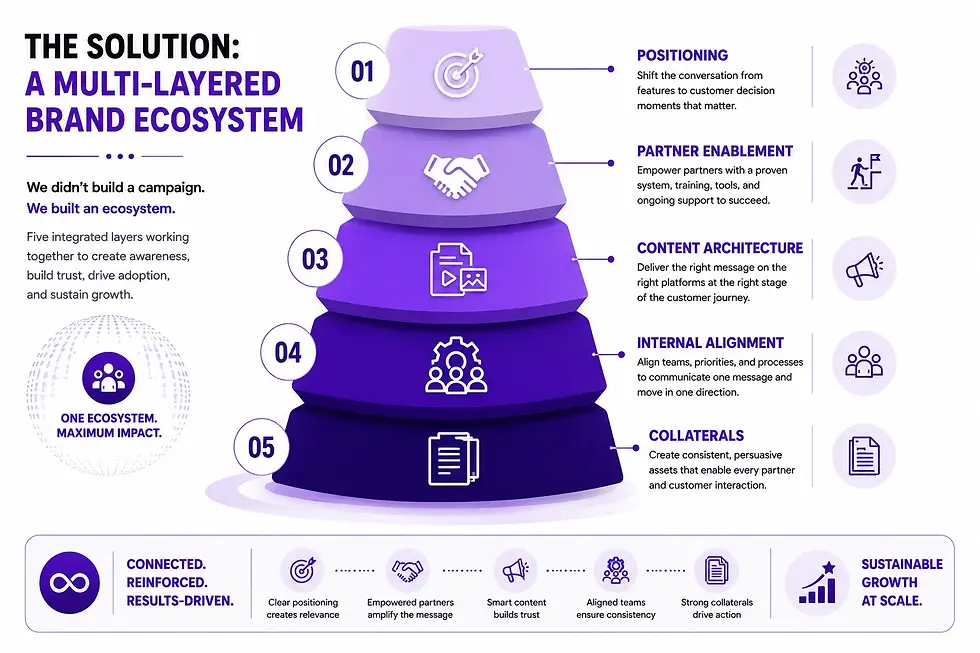
LAYER 1: BRAND POSITIONING TRANSFORMATION
The Old Positioning: "LAMF is a financial product with features X, Y, Z."
The New Positioning: "Before you redeem your mutual funds, here's a better option."
This simple repositioning did something powerful:
It addressed the moment of decision (when the customer needs funds)
It acknowledged their current behavior (they think they should redeem)
It offered an alternative (before you do that, consider this)
It interrupted the habit at the exact point when behavior change is possible
Framework Insight: Behavior change happens at decision moments, not at random exposure. You need to be present at the moment when your customer is thinking about taking action.
LAYER 2: THE 9-STEP PARTNER ACQUISITION & GROWTH SYSTEM
This was perhaps the most important piece. Because if partners don't understand and believe in your offering, nothing else matters.
Here's the system we built:
STEP 1: Targeted Onboarding
Identify high-potential MFD partners (not just any agent)
Quick, structured introduction to LAMF
Focus on clarity, not features
Why this matters: Not every partner is a fit. We focused on quality over volume.
STEP 2: Foundational Understanding
Provide quick learning modules (not long training)
Address confusion early: What is pledge? What is margin call? When does it happen?
Make complex concepts simple
Why this matters: Confused partners don't sell. Clear partners sell confidently.
STEP 3: Pitch Standardization
Create a fixed conversation flow (so partners aren't improvising)
Teach a 30-second pitch that works
Provide objection handling scripts
Why this matters: Consistency drives conversion. When every partner tells the same story, message sticks.
STEP 4: Habit Formation
Position LAMF as the "default before redemption"
Create a ritual: "Before any client redeems, we always check LAMF first"
Build this into the partner's workflow
Why this matters: Once LAMF becomes automatic (not something to decide), adoption explodes.
STEP 5: Proof-Led Selling
Provide real client case libraries
Show before/after outcomes (same client situation, different decision)
Build trust through evidence, not claims
Why this matters: Agents are skeptical. Data convinces them.
STEP 6: Simplified Communication
Provide WhatsApp-ready replies for common questions
Create objection cheat sheets (one-liners that work)
Make it easy for partners to have client conversations
Why this matters: Friction kills adoption. When communication is easy, volume increases.
STEP 7: First Success Support
Assisted onboarding for first 3 deals
Immediate escalation support
Celebrate early wins
Why this matters: First success builds confidence. Confidence builds momentum.
STEP 8: Performance & Tracking
Leaderboard (friendly competition)
Monthly metrics visible to all partners
Performance-based recognition
Why this matters: What gets measured gets managed. What gets celebrated gets repeated.
STEP 9: Recognition & Retention
Monthly awards (not just leaderboard)
Certification programs
Partnership tier advancement
Incentive programs
Why this matters: Long-term adoption requires ongoing motivation. Recognition sustains it.
Impact of This System:
383+ partners onboarded with standardized playbook
Partners went from confused → confident → autonomous
Reduced partner ramp-up time from weeks to days
Turned partners from reluctant to enthusiastic
LAYER 3: PLATFORM-WISE CONTENT STRATEGY ARCHITECTURE
Here's something most brands get wrong: They treat all channels the same.
We didn't. We assigned specific roles to each platform based on where customers are in their journey.
YOUTUBE = ATTENTION ENGINE (Awareness Stage)
Purpose: Create awareness and grab attention from people who don't know we exist
Formula: Problem → Tension → Twist
Content Breakdown:
60% Meme Hooks: "Kal karunga" (I'll do it tomorrow), "Emergency aayi toh" (When emergency hits)
These interrupt scrolling
They create pattern recognition
They make financial anxiety relatable
30% Situational Drama: Real-life scenarios showing the problem
"What happens when you need funds suddenly?"
"Market fell 20%, what now?"
"Unexpected expense, now what?"
These make the problem real, not theoretical
10% Light Explanation: Product fundamentals (but never sales)
"Here's what LAMF is" (not "buy LAMF")
"Here's how it works" (not "why it's better")
Education, not selling
Why this mix works:
60% hooks = people stop scrolling and watch
30% situations = people see themselves in the content
10% explanation = people get clarity
INSTAGRAM = TRUST ENGINE (Consideration Stage)
Purpose: Build trust, address concerns, establish credibility
Formula: Problem Recognition → Concern Acknowledgment → Practical Solution
Content Breakdown:
40% Situational Drama: Real customer stories
"Here's what happened to this customer"
"Their problem, their solution, their outcome"
Relatable, not salesy
30% Risk Clarity: Addressing the elephant in the room
"What IS margin call?"
"What happens if market falls?"
"Who controls my investment?"
These are the questions customers are too shy to ask
20% Authority Content: CMO perspective, expert insights
Why we built LAMF
How it fits into financial planning
What we believe about financial decisions
10% Product: Light education on features
How to use the app
What documents you need
Simple process walkthroughs
Why this mix works:
40% stories = relatability
30% risk clarity = addressing hidden objections
20% authority = building credibility
10% product = practical next steps
PRODUCT / APP = DECISION TOOL (Decision Stage)
Purpose: Make the final decision easy when customer is ready to act
Focus:
UX Copy: Navigation clarity, onboarding simplification, process explanation
Risk Communication: Simplified, reassuring language for complex concepts
Customer Journey: Streamlined from signup to first transaction
Trust Building: Security badges, customer reviews, instant responses
THE ARCHITECTURE INSIGHT:
Notice how these three layers work together?
YouTube brings awareness → Instagram builds trust → App converts decision
But more importantly: Each platform has a clear role. Each role serves a purpose. Each purpose moves customers closer to action.
This isn't random. This is strategic architecture.
LAYER 4: INTERNAL BRAND ALIGNMENT & EMPLOYEE CULTURE
Here's something most brands forget: Your employees are your first customers.
If your team doesn't understand your brand, doesn't believe in it, doesn't know how to talk about it—customers feel that gap.
So we held something called Liquify Day (annual brand workshop) where:
We brought everyone together (product, marketing, sales, operations, finance)
We addressed product clarity: "What is LAMF? How does it really work?"
We addressed risk concepts: "What is pledge? What is margin call? When does it happen?"
We addressed internal process gaps: "Where are we inefficient? What frustrates our customers?"
We addressed alignment: "Are we all on the same page? Do we all believe in this?"
We addressed employee concerns: "What are YOU worried about? What questions do YOU have?"
Results:
95%+ employee understanding of core concepts
Employees became brand ambassadors (not just employees)
Sales team felt confident talking about LAMF
Product team understood the customer problem (not just the feature list)
The Framework Insight: Internal alignment is the prerequisite for external impact. You can't ask customers to believe in something your team doesn't fully understand or believe in.
LAYER 5: COLLATERAL & EXPERIENCE TRANSFORMATION
Brand doesn't live in your logo. It lives in every touchpoint.
We transformed 800+ assets across the entire customer and partner journey:
Partner Assets:
Partner onboarding kits (beautiful, branded, easy to understand)
Certificates & recognition programs
Co-branded posters for their offices
Sales enablement toolkits
Customer Assets:
Website experience (simplified, trust-focused)
Email templates (consistent, clear)
Event collaterals (professional, memorable)
Internal Assets:
Employee t-shirts (wearing the brand)
Office signage
Internal presentations
Training materials
Event Assets:
Booth designs (2 complete setups for different events)
Signage & branding
Merchandise & giveaways
Partner event collaterals
Digital Assets:
Social templates (consistent across all platforms)
Email templates
Landing pages
Presentation decks
PART 3: THE OUTCOMES — WHAT ACTUALLY HAPPENED
The Qualitative Impact
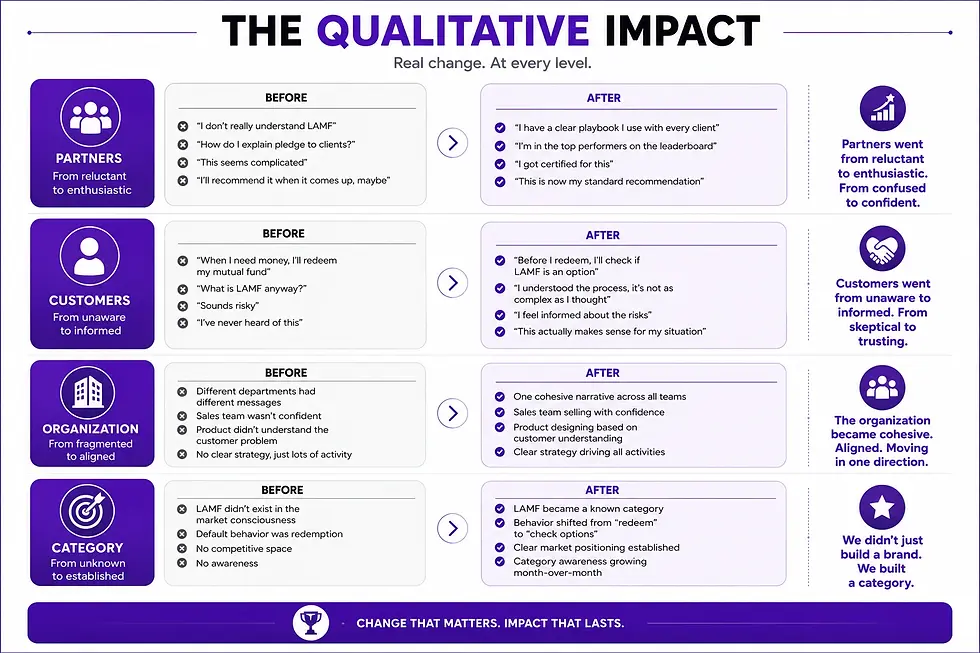
What Changed for Partners
Before:
"I don't really understand LAMF"
"How do I explain pledge to clients?"
"This seems complicated"
"I'll recommend it when it comes up, maybe"
After:
"I have a clear playbook I use with every client"
"I'm in the top performers on the leaderboard"
"I got certified for this"
"This is now my standard recommendation"
Partners went from reluctant to enthusiastic. From confused to confident.
What Changed for Customers
Before:
"When I need money, I'll redeem my mutual fund"
"What is LAMF anyway?"
"Sounds risky"
"I've never heard of this"
After:
"Before I redeem, I'll check if LAMF is an option"
"I understood the process, it's not as complex as I thought"
"I feel informed about the risks"
"This actually makes sense for my situation"
Customers went from unaware to informed. From skeptical to trusting.
What Changed for the Organization
Before:
Different departments had different messages
Sales team wasn't confident
Product didn't understand the customer problem
No clear strategy, just lots of activity
After:
One cohesive narrative across all teams
Sales team selling with confidence
Product designing based on customer understanding
Clear strategy driving all activities
The organization became cohesive. Aligned. Moving in one direction.
What Changed for the Category
Before:
LAMF didn't exist in the market consciousness
Default behavior was redemption
No competitive space
No awareness
After:
LAMF became a known category
Behavior shifted from "redeem" to "check options"
Clear market positioning established
Category awareness growing month-over-month
We didn't just build a brand. We built a category.
PART 4: THE FRAMEWORKS — WHAT WE LEARNED
Framework 1: The Behavioral Change Model
Most brands focus on awareness. They assume:
More visibility = More understanding = More conversions
But awareness alone doesn't change behavior.

Where most brands fail: They focus on steps 1-2. But behavior change happens at step 4 (decision moment).
What we did: We built systems to address every step, with special emphasis on being present at the decision moment with the right message.
Insight: You need to reach customers where they are making the decision, not where they're casually browsing.
Framework 2: The Multi-Audience Brand Ecosystem Model
Brands usually think in terms of one audience: the customer.
But your brand impacts multiple audiences:

Each audience has different needs, different concerns, different questions.
What we did: We designed systems for each audience, not just campaigns for customers.
Partners got enablement playbooks
Employees got alignment workshops
Customers got trust-building content
Product got communication guidance
Insight: A brand is only as strong as its weakest audience. If partners aren't confident, customers sense it. If employees don't understand, quality suffers.
Framework 3: The Platform Role Clarity Model
Most brands ask: "Which platform should we be on?"
But the better question is: "What role should each platform play?"

Insight: Don't use YouTube to convert. Don't use your app to build awareness. Each platform has a role. Play to its strength.
Framework 4: The Decision-Moment Interruption Model
Here's the key insight that made everything click:
People don't change behavior because they saw an ad. They change behavior when they're making a decision and encounter a better option.
So the question isn't: "How do we create awareness?"
The question is: "When is the moment our customer makes a decision about this? And how do we be present at that moment with the right message?"
For LAMF:
Decision moment: "I need funds. Should I redeem my mutual fund?"
Our intervention: "Before you redeem, here's another option"
Why it works: We interrupt the habit at the moment it's being executed
Insight: Identify the decision moments in your customer's journey. Design your entire strategy around being present at those moments with the right message.
Framework 5: The Clarity-Over-Features Model
Most marketing focuses on features:
"This product has X, Y, Z capabilities"
"Here's how it's different from competitors"
"Look at our advanced technology"
But customers don't buy features. They buy outcomes.
More importantly: Confusion kills conversions.
So we flipped the model:
From: Features → Benefits → Outcomes To: Understanding → Trust → Outcomes
Content focused on:
"Here's what you're worried about"
"Here's the simple explanation"
"Here's how it actually works"
"Here's real proof it works"
Not: "Here's our features"
Insight: In a complex product space, clarity is your competitive advantage. Make it simple, not comprehensive.
Framework 6: The System-Based Growth Model (Not Campaign-Based)
Traditional brand building is campaign-based:
Launch campaign → See results → Launch another campaign
But campaigns are temporary. Systems are permanent.
What we built were systems:
The 9-step partner playbook (reusable, scalable system)
Platform-wise content architecture (repeatable framework)
Internal alignment process (annual ritual, not one-time event)
Decision-moment intervention (ongoing strategy, not campaign)
Why systems work better:
Campaigns require constant new ideas
Systems require initial design, then repetition
Campaigns have short-term impact
Systems have compounding impact
Campaigns need creative genius
Systems need clear documentation and execution
Insight: Design systems, not campaigns. Systems scale. Systems compound. Systems become habits.
PART 5: THE CHALLENGES — WHAT DIDN'T WORK (AND WHY)
Let me be honest about what we tried that didn't work:
What Didn't Work:
Initial "Educational" Campaign
We created long-form explainers about LAMF
Engagement was terrible
Why: People don't want education when they're unaware. They want to feel something first.
Lesson: Don't educate the unaware. Grab their attention first.
Feature-Focused Messaging
We listed LAMF features and capabilities
Customers didn't care
Why: Features aren't benefits. Benefits aren't outcomes.
Lesson: Customers care about their problem, not your features.
Partner Email Blasts
We sent partners information via email
Adoption was slow
Why: Email alone doesn't build confidence. Partners need conversations, training, support.
Lesson: Can't scale enablement via email. Need systems and human touch.
Generic Events
We held partner events that were about the company, not the partner
Attendance was low
Why: Partners don't care about your story. They care about their success.
Lesson: Events should solve partner problems, not tell company story.
Campaign-Focused Thinking
We designed "campaigns" instead of "systems"
Results didn't compound
Why: Campaigns end. Systems continue.
Lesson: Design for long-term compounding, not short-term spikes.
The Outcomes: What Changed
Here's what the transformation actually looked like across all our audiences...
3.2M+ impressions across YouTube and Instagram
383+ partners onboarded
37% partner adoption growth
24% increase in customer confidence
Category awareness: 11% → 31%


Comments