From Noise to Signal: Rebuilding Brand Trust in a Crowded NBFC Market

CHALLENGE
Strengthen brand visibility and simplify financial product communication in a competitive market
India's NBFC sector is one of the most commoditised financial categories in the country — dozens of lenders competing with near-identical product messaging, visual identity, and channel presence. Ratnaafin Capital, despite offering strong financial products, faced two compounding problems: low brand visibility in the market, and inconsistent communication that failed to simplify or differentiate. Customers could not articulate what Ratnaafin stood for. Neither could the brand.
Diagnostic Framework: 3C Brand Audit + STP
3C Brand Audit (Company · Customer · Competitor) + STP [DIAGNOSTIC FRAMEWORK]
Before any strategy was set, a rigorous brand audit was conducted to understand exactly where the brand was broken — and where the opportunity lived. The 3C + STP model was used to ground every subsequent decision in evidence.

INFOGRAPHIC SUGGESTION
Visual: Three overlapping circles (Company / Customer / Competitor) with STP outputs listed in a callout strip below — use brand colors coral, teal, and amber for each circle. Add directional arrows pointing inward to represent convergence on a single positioning statement.
Strategic Mandate
"Simplify what we say. Strengthen where we say it. Ensure every touchpoint tells the same story." |

Taking full strategic ownership, the mandate spanned four inter-dependent work streams, each with its own framework, process, and stakeholder map — all activated simultaneously.

Work Stream 1: Brand Strategy & Messaging Architecture
House of Brand Framework — 4-step messaging architecture

Work Stream 2: ATL & BTL Campaign Execution (RACE Framework)
RACE Framework — Reach · Act · Convert · Engage
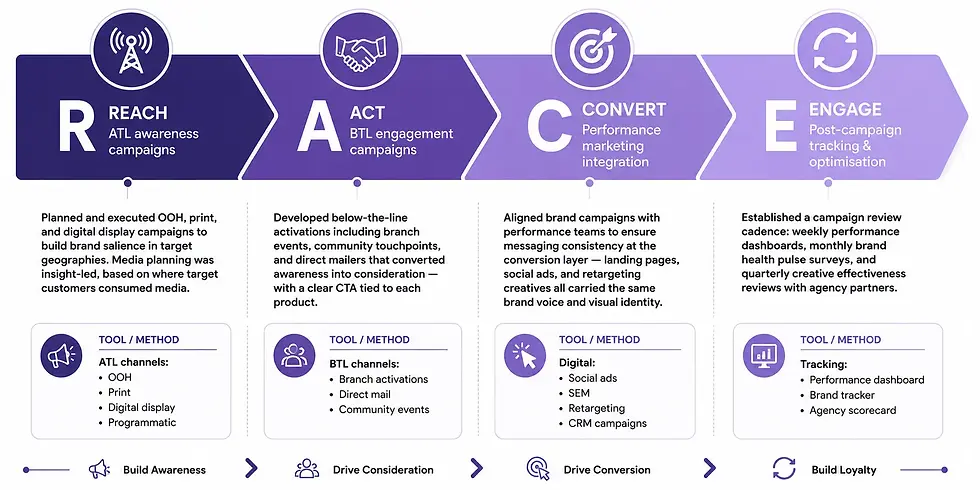
Work Stream 3: Research & Insights Engine (Listen → Analyse → Act)

Work Stream 4: Stakeholder & Operations Management (RACI + Vendor Governance)
RACI Ownership Matrix
RACI Role | Who | Responsibility |
Responsible | Brand Manager | Strategy, briefing, campaign execution, vendor mgmt |
Accountable | CMO / Business Head | Final sign-off on brand direction and budget |
Consulted | Product, Sales, Legal | Input on product accuracy, compliance, sales alignment |
Informed | CEO, Regional Heads | Quarterly brand performance updates |
3-Gate Creative Review Process
Gate 1: Concept | Strategy brief reviewed, insight cited, messaging hierarchy checked before creative work begins. |
Gate 2: Draft creative | Creative draft reviewed against tone of voice guide and brand compliance checklist. |
Gate 3: Final sign-off | Final asset reviewed for compliance, channel fit, and stakeholder approval before release. |
Vendor Governance Model
Agency briefing | Standard brief template used for every project; insight citation mandatory |
Budget tracking | Weekly PO reconciliation and monthly budget review against plan |
Performance review | Quarterly agency scorecard covering quality, timeliness, and brand adherence |
Stakeholder updates | Monthly brand performance report to CMO; quarterly to leadership |
Impact & Outcomes
↑ Lifted Brand visibility | ↑ Unified Comms consistency | ↑ Distinct Market positioning |
Brand salience • Improved recognition in target segments • Consistent ATL presence across geographies • Unified visual identity across 40+ touchpoints | Communication clarity • Product messaging simplified to everyday language • Customers could articulate brand value proposition • Reduced confusion at the conversion layer |
Execution efficiency • Stakeholder alignment reduced revision cycles • Faster campaign delivery within budget • Agency governance improved creative quality | Competitive positioning • Clear white space in NBFC category: accessibility & warmth • Differentiated from product-led competitor messaging • Insight-led positioning resonated with first-time users |


1 Comment